
Our City Our Say’s silent “compromise” leaves supporters wondering what’s next
Columbus City Council President Shannon Hardin apparently did not take the pledge of silence. Or he did take the pledge but broke it after being quoted in WOSU’s story regarding Our City Our Say’s “compromise” with City Council.
If you are not in the know, and you have a good excuse as to why, Our City Our Say and some of its leadership demanded the coalition take a pledge of silence about a potential compromise the grassroots movement could make with City Council. This pledge, verified by multiple sources, took place last Tuesday at the Parsons Avenue library with roughly 40 coalition members in attendance (Hardin was not present at the meeting). Our City Our Say is also telling members and supporters to not post anything to social media about any compromise.
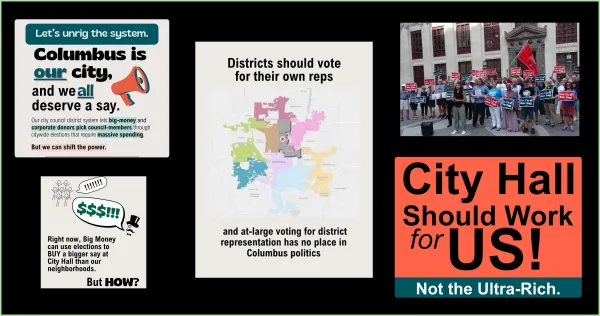
Our City Our Say is seeking to end the nine at-large “fake” Council districts and replace them with a more democratic system where voters in each district choose their preferred candidate who must reside in the district. Columbus is one of a handful of large American cities still voting “at-large” for council members. A perfect example of how the current system is not true-district based representation occurred last November when District 7 voters elected Jesse Vogel for both the primary and final election but he lost the at-large final election vote to Tiara Ross.
Our City Our Say in July gathered the necessary number of signatures – roughly 23,000 – to be on November’s ballot. The signatures were submitted to the City Clerk on July 16, but since then some leadership of Our City Our Say has privately met with Hardin and other City leaders to come up with the so-called compromise. Who exactly from Our City Our Say is meeting with Hardin and others is not clear.
The compromise being discussed would allow for nine true voting districts but also add four at-large council members. When word began to spread that Our City Our Say was now supporting the idea of four at-large council members there was immediate backlash.
The essential problem with the compromise, claimed critics, is how anti-establishment or activist candidates won’t have the finances or influence to compete against “Columbus Way” approved establishment candidates who will have a stranglehold over the four at-large seats. Thus keeping the current establishment dominance on City Council in place.
Hardin, who was very careful with his statement to WOSU, did not offer any specifics about how any potential comprise with Our City Our Say would play out.
“I appreciate the candid, good faith conversations that we’ve been having with advocates about how we can work together for reform. It’s too soon to say where that dialogue will land, but we’ve found common ground, and one way or another, residents will get to make choices this November about the city’s future,” he said.
What happens next is not clear. Will there, for instance, even be an Our City Our Say ballot measure on the ballot in November? The Our City Our Say members we spoke with simply don’t know. Again, this is because a select few individuals from Our City Our Say are keeping their conversations with city officials locked down.
What long-time editorial members of the Free Press do know is that the Columbus establishment – mostly Democrats by the way – have offered compromise before, but in the end, the activists were played the fool. For instance, City Council, going back decades, promised reforms to the Columbus Division of Police, but they never materialized. To be clear, some police reforms did come to fruition after the George Floyd-summer of 2020.
More pertinent is how activists have tried several times in the past to amend the city charter and create true district representation by City Council. Back in 2011, the Columbus Coalition for Responsive Government petitioned for an ordinance creating district-only voting for seven seats but also included four at-large seats.
What happened then and in other instances is that City Council hijacked the idea and twisted it to their liking. One reason why we have the current system of “fake districts”.
As one long-time activist once connected to the Columbus Coalition for Responsive Government told us, “They’re (Our City Our Say) having something similar happened to them that happened to us. It’s pretty idiotic and completely easy to anticipate.”